Terranima

Green Roots Festival: suolo, persone e semi di rigenerazione

Terranima Festival GReenroots

Green Roots Festival: Soil, People, and the Seeds of Regeneration Badolato, Calabria – June 12–13, 2025   What happens when you bring together farmers, gardeners, dreamers, and doers from all corners of Calabria? When young people and elders, city dwellers and countryside veterans sit under the same olive tree to learn about soil life and microbial magic? Something powerful happens. Something that feels like regeneration—not only of agriculture, but of community. This was the spirit of the Green Roots Festival, a two-day workshop on regenerative farming and soil microbiology held at Terranima’s land in the hills of Badolato. The event was supported by the Erasmus+ Programme of the European Union and hosted in collaboration with Slovak Eco Quality (SEQ).   From the very beginning, the energy was palpable. Participants arrived curious, open, and ready to dive in. Over 30 people each day, from different parts of Calabria and beyond, gathered to learn from Axel Torrejón, a Chilean agroecologist and consultant known for his engaging, hands-on approach to teaching. And the group? A beautiful mix. Farmers in their sixties stood next to young students; local food producers swapped ideas with hobby gardeners and permaculturists. It wasn’t just about microbes—it was about connection. Between people, between generations, and between humans and the soil. Soil, microbes… and something more Over two days, participants explored key concepts of soil health, plant nutrition, and natural resilience. They learned how to prepare biofertilizers, grow beneficial microorganisms, and even trap native fungi and bacteria from the local environment using simple, low-cost techniques. But more than that, they learned how to observe nature. Axel’s teaching style made even the most complex microbiology feel accessible. Despite the heat, the group stayed fully engaged. Laughter, questions, and “aha!” moments flowed freely. And when it came to the practical parts? People got their hands dirty. They mixed, observed, built, shared. Some even took rice traps home to see what tiny life forms they could collect from their own land. Regeneration Soil and Society There’s something special about watching strangers become collaborators. About seeing young people ask questions with spark in their eyes, and older farmers nod in deep understanding. What emerged during the festival was a kind of social regeneration—a reminder that agriculture isn’t just about food. It’s about culture, landscape, health, identity. And when people who care about these things come together, something begins to shift. Terranima aims to become a reference point for this kind of transformation—connecting people who share values and visions, and offering a space where new ideas can take root. Slow lunches, big ideas The long lunch breaks weren’t just about food (though the food was delicious). They were a time for networking, reflection, and exchange. People sat in the shade, shared stories, and made plans. Some want to collaborate. Others want to bring Axel back. Everyone wanted more. In fact, the most frequent feedback we received? “Let’s do this more often!” A community effort   None of this would have been possible without the incredible volunteers—Simone, Yamila, and Veda—who helped organize, host, guide, and support every detail of the event. Also, thanks to our neighbours and friends who agreed to use their space for parking, or borrowed chairs and straw bales. And yes, no plastic was used: everyone had a reusable cup labeled with a clothespin for their coffee and water. Looking Ahead The Green Roots Festival was just the beginning.   The response from participants was clear: there’s a real hunger in Calabria for practical knowledge, inspiration, and community around regenerative practices.   We’re already dreaming of the next edition—maybe in a cooler season, and maybe spread out over more days to give even more space for reflection and participation.   The seeds have been planted, and we can’t wait to see what grows. Special thanks to the Erasmus+ (Programme of the European Union), to our friends at Slovak Eco Quality (SEQ, Marco, Gabriela, Agnes and Kristina, and from BROZ.sk with Karolina and Mario), to Axel Torrejón for his passion and clarity, to Chiara and Paola for their help with translating, and to everyone who showed up ready to learn and share.   And of course, our deepest thanks to the volunteers, without whom none of this would have been possible.   Let’s keep growing, regenerating, and rooting ourselves in what matters. Participants during the event Axel showing some of the treatments Some of the preparations with rice and milk Participants Participants smelling soil Axel in action Axel explaining soil health Networking Networking Networking Axel presentation Participants Overview of the workshop Axel presenting Participants Chiara and Paola who helped with translation Marco and Gabriela from SEQ Group picture

Green Roots Festival: suolo, persone e semi di rigenerazione Leggi tutto »

Cos'è una "gilda"?

What is a guild? In permaculture, a guild refers to a carefully designed and interconnected group of plants, animals, fungi, and other elements that work together synergistically in a sustainable and productive ecosystem.   The main principle behind guild design is creating a diverse and resilient system, where each element performs multiple functions and supports the overall productivity of the ecosystem.   A permaculture guild typically consists of several key components:   Central Species: At the core of a guild, there is usually a main plant or tree species that serves as the focal point or primary provider of resources. This central species is often a long-lived perennial (for example a tree) that forms the backbone of the guild. Companion Plants: Surrounding the central species are a variety of complementary plants, known as companion plants. These plants are carefully selected to fulfill specific functions that support the overall health and productivity of the guild. They may provide additional resources such as nitrogen fixation, pest control, pollination, nutrient accumulation, or shade regulation. Beneficial insects and animals: Guilds incorporate beneficial insects and animals that play important roles in pest management, pollination, soil aeration, or nutrient cycling. For example, certain plants may attract predatory insects that control pest populations, while flowers can attract pollinators like bees and butterflies. Soil Enhancers: Guilds often include plants or organisms that contribute to soil fertility and health. Nitrogen-fixing plants, such as legumes, convert atmospheric nitrogen into a form that other plants can utilize. Dynamic accumulators, like comfrey or yarrow, draw nutrients from deeper soil layers and make them available to shallower-rooted plants when their leaves decompose. Mulch and / or Ground Covers: Ground covers and mulch plants are employed to protect the soil from erosion, conserve moisture, suppress weeds, and provide organic matter as they decompose. These plants, such as low-growing herbs or spreading perennials, also serve as living mulch, creating microclimates and optimizing resource utilization within the guild.   By carefully selecting and arranging plant species and other components based on their functional relationships, we aim to create self-sustaining and low-maintenance systems that mimic the balance and efficiency of natural ecosystems.  The exact composition of a guild will depend on the specific goals, climate, and local conditions of a particular site. Left picture: Guild around a young olive tree with various perennial herbs and some annual fruit and vegetable plants.   When it comes to guilds with olive trees, there are several companion plants that can be beneficial in enhancing the overall health and productivity of the olive tree ecosystem.   Picture at the right: view of the companion plants we chose for our olive tree. Other good companion plants for an olive tree guild could be: Borage (Borago officinalis), Fennel (Foeniculum vulgare), Marigold (Tagetes spp.), Nasturtium (Tropaeolum spp.). I. Comfrey (Symphytum spp.): Comfrey is an accumulator plant and known for its deep taproots that can mine nutrients from deep in the soil. It accumulates minerals and makes them available to other plants, making it an excellent choice for almost any type of guild. Its huge leaves create lots of shade and help suppress unwanted weeds. Note: We have placed the comfrey in the shade of the olive tree (north side) as it still is difficult to grow comfrey in our climate. Comfrey generally prefers half-shade and cooler temperatures. With a thick woodchip mulch layer, which is reducing surface temperature considerably, we hope that the comfrey will thrive here.   II. Lavender (Lavandula spp.): Lavender attracts pollinators and beneficial insects while repelling pests. Its aromatic foliage can also help deter pests from olive trees. III. Thyme (Thymus spp.): Thyme is a low-growing herb that can act as a living mulch around the base of olive trees, suppressing weeds and conserving moisture. It also attracts pollinators and repels certain pests. IV. Rosemary (Rosmarinus officinalis): Rosemary is a hardy herb that can thrive in the same conditions as olive trees. It attracts bees and other beneficial insects while providing some shade to the soil around the tree.   V. Ballota (Ballota acetabulosa): The flowers of this herbaceous plant are attractive for bees and when big enough, the leaves will work as a ground cover. VI. Incense (Plectranthus madagascariensis): Incense attracts insects, pollinators and butterflies and therefore also birds to the garden.The leaves and branches of this species give off a strong scent and are sometimes used to ward off flies. We’re hoping to keep away the nasty flies that puncture the olives! VII. Sugar melon (Cucumis melo): This melon is an experiment – we are very curious as to how well annual vegetables can do around an olive tree. So far, the plant looks quite happy, growing a first little melon. With its beautiful flowers, this melon will attract pollinators and create shade / ground cover with its big leaves Remember to consider the specific growing conditions, climate, and region when selecting companion plants for your guild. It’s also beneficial to choose plants that have similar water and sunlight requirements to ensure they thrive together.

Cos'è una "gilda"? Leggi tutto »

Costruire la nostra area di compostaggio

Building our composting area Compost production is at the heart of our regenerative practices and having a proper space to produce it seemed an important milestone in our journey.   It all started from the wish to professionalize our compost production. At the beginning, we were making our compost outside, having to protect our piles from sun, wind, and rain. A fully covered area would give us the benefit of working in the shade and protect our fresh piles and the finished product from too much heat, wind or humidity. All of which contributes to a better product in the end: a rich, dark compost, that is full with microbial life. It all starts with a rough sketch… So, the task at hand was to construct a spacious, covered area that would allow us to have more control over the entire process while making our lives a bit easier at the same time. We always try to design our systems with a permaculture approach – each element performs many functions. Thus, the new building should not only help us to produce compost, protect us and the compost from the elements but should also integrate in the existing systems. That’s why the “relative location” of each element is crucial. By placing it right next to (and one terrace level up from) the main garden, we can choose to gravity-feed our veggie garden by connecting the liquid compost tank to the irrigation system. This way, we save ourselves a lot of time and effort. Future plans involve adding animal stables right next to the compost area, which is another example of a “relative location”. The need for fresh manure in our compost production makes the placement of animal stables right next to it a smart choice. The building process After having found the right location, we started out with a rough sketch, some measuring, and the help of many volunteers. We had to select the right logs for the pillars, shave the bark off of them and bury them 1m deep in the compacted clay soil. Picture at the right shows the first task completed: Coco and Chris are celebrating the accomplished burying and aligning of the pillars. Now that the pillars were in place, we started to connect them with horizontal crossbeams. On top of these connectors, we had to fix other logs using simple joinery. Even though it was basic woodworking, the irregularity of roundwood has got its challenges. Nevertheless, we were determined to spend as little money as possible (as opposed to buying more processed – meaning square – pillars and beams) and we simply love the “rinky-dinky” style of building with roundwood. As soon as the main structure was up, we could cover the roof. We decided on rough boards from locally sourced Douglas firs. To protect the roof from rain, we used overlapping rows of tar paper. We heated the tar paper at the edge where the rows overlap in order to glue them together properly. Finally, it was time to take care of the work area itself. After some debating whether to use cement or not, we’ve decided to pour a cement floor for half of the building. We wanted a flat and clean workspace for storing the finished compost and more importantly, placing the brewing tank for our liquid compost production. We boarded up the walls on the two “wheater sides”, to protect from winds and precipitation from north and west. Leaving enough space on top of every wall would grant us enough natural light and also lessen the wind pressure on the structure. All we had to do now was installing water and power lines and build a wooden platform to carry our 600lt tank. We’ve also included a ladder and service platform on top of it to be able to easily access and clean the residues inside the tank after each brewing process. We’ve already used it many times and it works perfectly! The elevated platform provides some altitude to empty the tank without any pump or power, simply using gravity. In the future, we’re planning to install a wind turbine and batteries to hopefully generate enough electricity for the air pumps, which are needed to produce a high-quality liquid compost (tea & extracts). Another future project is to harvest the rain water from the roof to further minimize the environmental impact in our compost production. Surely, we’ll be looking for the best possible “relative location” of the rainwater catchment system to ensure that it’ll be also adhering to the permaculture principle of “each element performs many functions”. For now, we’re super thrilled to be able to work efficiently and produce one of our main assets, a dark, rich, microbially active compost in larger quantities.   This will speed up the regeneration process of all the parts of our land, be it the olive groves, the food forest, or our veggie gardens.

Costruire la nostra area di compostaggio Leggi tutto »

More fruit trees – Starting a food forest!

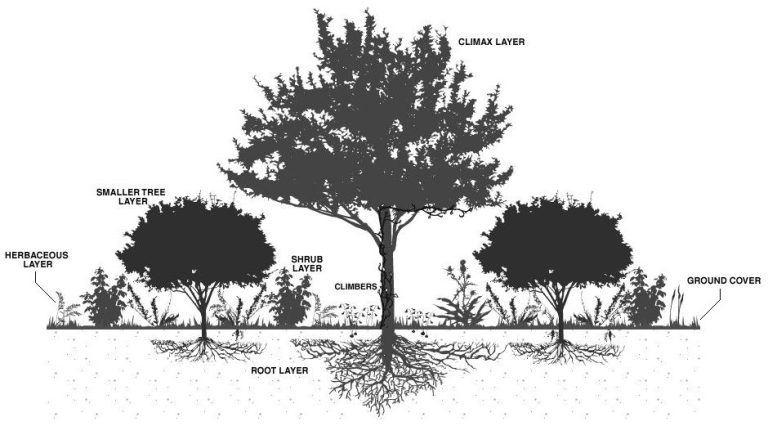
Building our food forest A Food Forest Takes Root The land came to us already generous — an old orchard planted by Teresa Fiorenza. Here’s how we began turning it into a food forest: swales, saplings, and compost alive with fungi. This piece of land came to us already generous. For years it has given us medicinal herbs, fruit and all kinds of edible plants — most of them put in the ground long ago by the previous owner, Teresa Fiorenza, a gentle old woman who likely lived through hard years during and after the Second World War. Thank you, Teresa. We inherited an abundance of perennials and trees: loquat, artichokes, mulberries, dates, peaches, plums, apricots, almonds, figs, pears, apples, persimmon (kaki), jujube, pomegranates, walnuts, hazelnuts, lemons, oranges, mandarins, citron (cedro) and bergamot. There are few luxuries quite like eating fruit still warm from the tree. But it doesn’t stop there. Continuing Teresa’s legacy — and our own path toward self-sufficiency — we began planting new trees around the house: the sub-tropical Moringa oleifera and carob (Ceratonia siliqua), along with some fig and oak. New trees for the future food forest. Young carob sapling. The best time to plant a tree was 20 years ago. The second best time is now.— Chinese proverb In the older orchard we added two varieties of apricot, two of apple, quince, flat peach (Prunus persica var. platycarpa), regular peach, mulberry and plum. Along a cliff, in a more shaded spot, went white, red and black currant, red gooseberry, blueberry and raspberry. On the flatter part of the future food forest we shaped swales — a trench-and-berm running along the contour (a line of equal altitude) to catch and hold as much rainwater as possible for the trees. Ours are really semi-swales: interrupted, and not perfectly on contour. Aerial view of the food forest area, showing potential water collection in the swales (in blue). Tree planting The future food forest, with freshly dug swales. We dug the planting holes on the uphill side of each swale, roughly 40–50 cm deep and wide — big enough for the roots to grow on before they meet the native soil, which tends to be more compacted. Each tree gets more water this way: the swale’s ditch lets surface run-off infiltrate straight into the root zone. Planting hole. To give the young trees a head start, we layered seasoned compost between the native soil. The point of adding our own compost is to inoculate the ground with the most diverse microbiology we can — beneficial bacteria and, above all, beneficial fungi. This is the main reason we set up our Soil Lab. Under the microscope we can judge the quality of our own compost and soil, and identify which members of the Soil Food Web are present — the beneficial ones, and the ones we’d rather not see. It lets us make better decisions. For the trees, we used a compost richer in fungi than in bacteria. Trees sit later in ecological succession, and later-succession plants tend to take their nitrogen as ammonium (NH₄⁺) rather than nitrate (NO₃⁻). Fungal-dominated soils hold nitrogen in that ammonium form; bacterial-dominated soils tip it toward nitrate — which is exactly what early-succession plants and most weeds prefer. Matching the soil’s biology to the plant is the whole game. Adding a rich mix to the planting hole — seasoned compost and topsoil. Before setting each sapling in, we carefully teased open the root ball once it was out of its pot, to prevent girdling. Loosening the root ball matters for how the roots develop. What is “girdling”? In nursery pots, roots hit the wall and start circling. Loosening the root ball breaks that circling habit, so the tree is far less likely to keep spiralling once it’s planted. We also dug square holes, hoping a few roots would find a corner and cross more easily from hole to native soil. Finally, we drove three fence posts into the ground around each sapling (careful not to spear the root ball). Once the summer drought sets in and the drip irrigation comes on, the wild boars will smell the water at once — there’s little of it around in summer — and mistake a damp swale for a ready-made mud bath. Rolling around happily in it, they can damage or even uproot a young tree. Here’s hoping the posts keep the saplings safe. Creating a “food forest” (or “edible landscape”) What is a food forest? A food forest — or forest garden — is a diverse planting of edible species that imitates the patterns and relationships of a natural ecosystem. It’s a three-dimensional design, with life reaching in every direction: up, down and out. Once established, it doesn’t need replanting year after year, and it’s generally very resilient. Source: Resurgent Circles – Seeding Eden (modified by us). We usually speak of seven layers in a forest garden: the overstorey (canopy), the understorey (smaller trees), the shrub layer, the herbaceous layer (grasses, medicinal plants and so on), the ground-cover layer (perennials like clover), the root layer (root vegetables) and the vine layer (climbers). Some add an eighth — the mycelial layer, the mushrooms. Stacking these layers lets us fit far more plants into one area without them failing from competition. The food forest area, marked with a red dotted line. A food forest has to be organic. Forest gardens lean heavily on a healthy ecosystem; they can’t be sprayed with herbicides or pesticides, or fed synthetic fertilisers. That ecosystem takes several years to settle in — so we have to be patient and let nature do its work, while providing the food, water and habitat every part of it needs. Without those, they simply won’t come. Food forests are a new idea in our corner of Calabria, but people have been growing them for thousands of years elsewhere in the world. Adding some seasoned high-fungal compost to an orange tree. A well-designed forest garden earns its

More fruit trees – Starting a food forest! Leggi tutto »

The vegetable garden – our first big project

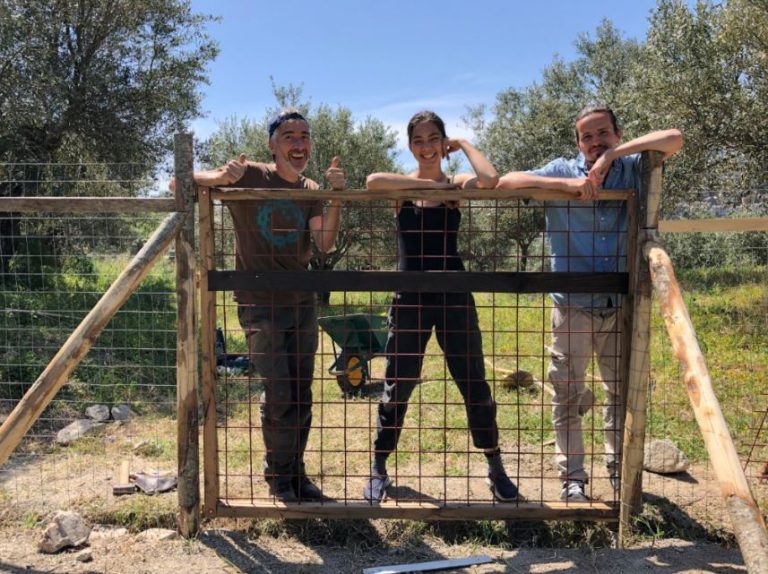
From our first season on the land Our First Garden From a bare, boar-threatened terrace to beds full of tomatoes, courgettes and Fibonacci spirals — how the garden at Badolato began. Our first big project on the land was a garden. It was 2020, and with the uncertainty the pandemic had brought, we decided a slightly oversized vegetable garden wouldn’t be a mistake — something that could feed six people or more, in case self-sufficiency arrived sooner than we’d planned. We chose a sunny 500 m² terrace that runs along the steep, forested valley-side, down toward the river 150 m below. Four small olive trees already stood on it, and rather than clear them we folded them into the design as shade. But before any of that, we needed a fence — the wild boars that roam these hills had been described to us, by nearly everyone, as a plague. Protection against wild boars Why so many boars? The usual answer is that the predators that once kept them in check — wolves, above all — are gone. The locals tell another story too. As the legend goes, a farmer once tethered a domestic sow and let a wild boar impregnate her; some of the offspring escaped, carrying both wild and domesticated genes. Where a true wild boar farrows once a year, these hybrids could breed up to three times, with as many as twelve young at a time. Whichever version is true, we soon found holes torn in the older fences elsewhere on the land, and followed the trails to patches turned over by a passing troop. The damage stayed moderate — they never reached the olive roots — but the warning was clear. So we dug a trench, 50 cm deep and 30 cm wide, and set more than a hundred chestnut hardwood poles into it, one metre apart, wedging granite stones around each to hold it fast. We filled the rest of the trench with more granite and rubble the previous owners had left behind. Over the 150 cm-high fence we then fixed a metre of heavy-duty steel mesh, buried about 30 cm into the ground. Our volunteers Angi and Joel finished the job with two well-built gates, made to shrug off any boar with a running start. After weeks of hard labour, we could finally begin the actual garden. Preparing the beds and soil The existing soil was badly compacted, so we loosened it with digging forks. Over it went a first layer of dry leaves and cardboard to hold down the thick grass and weeds pushing up from below. We were lucky to salvage a few cubic metres of old, supposedly fertile soil from a ruin in town, where a great fig tree had been growing for decades. We topped the beds with a 10 cm layer of this mix — adding some old chicken manure we’d found in a barrel, by then almost fully broken down to soil — then watered everything well to moisten the beds and the cardboard beneath. The fun begins Now the good part: planting. Soon after arriving we’d germinated a wide variety of seeds, in season or not — many of them brought with us, with no idea whether they’d take to the far hotter southern climate. In went tomatoes, basil, peppers, pumpkins, courgettes, cucumbers, strawberries, leeks, lettuces, onions, carrots, broccoli (out of season, as it turned out — it grew like mad and bolted straight to seed), beans, beetroot, chard, corn, and more to follow as new beds were ready. Our volunteer Diego built us a broad fork that loosens the soil with your whole body rather than just your hands. We mulched around every seedling to slow evaporation and weeds. May was no time to find fresh straw, so we used what was left from the year before — much of it rained-on — and some mouldy bits must have slipped in, because a few beds sulked for weeks. Only once we’d stripped that mulch away, or swapped it for our own wood chips, did they suddenly come alive. Planting carrot seeds between rows of onion seedlings. Later we added more organically shaped beds: a spiral built to a Fibonacci ratio, two keyhole beds, and a hügelkultur mound in the shape of a gecko. For the little we put in, most beds gave a good yield — and for a first spring and summer, we were more than happy with how it all came on. Thanks to Yvonne’s extraordinary cooking, we ate our way through countless wonderful vegan meals — a luxury that kept the rest of us fed, happy and free to focus on the work. Thank you, Yvonne, for the love you brought to this place. And we won’t forget Markus’s raw cakes, easily the equal of any five-star kitchen — thank you too, Markus, gifted cake-maker and builder of useful things, vermicompost bins included. The small house garden We also made a small garden by the house, running along and beneath a pergola shaggy with grapevine. Inside its fence we kept the lemon, loquat, plum and fig trees that were already there. With the irrigation reaching them from the surrounding garden, these trees should fruit far more heavily over the years; in return, they shade the plants below from the harshest sun. The little wooden bench Mario and Markus built invites anyone to pause among the flowers and greenery. If you’d like to follow where this garden — and everything that grew from it — has gone since, join our community and our newsletter.

The vegetable garden – our first big project Leggi tutto »

it_ITIT