Terranima

Le piante non sono vegetariane
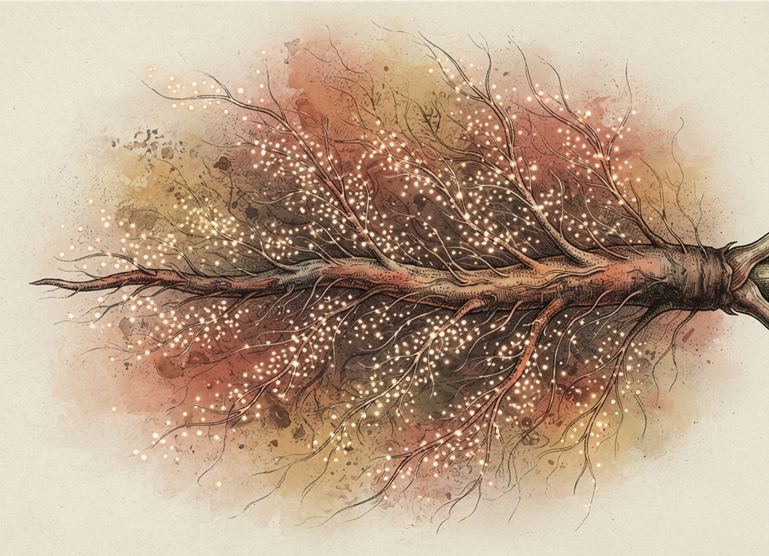
From under the microscope Plants Are Not Vegetarians What a microscope keeps showing us about how roots really eat — and what we’ve quietly bred out of our seeds. It sounds like a provocation. But the longer we spend with soil under the microscope, the more literally we mean it. For most of the last century we pictured a root as a straw. Passive. Sipping dissolved minerals from the water around it, the way you draw lemonade through a paper tube. Nitrogen in, phosphorus in, potassium in — a plumbing problem, and one we learned to “solve” by pouring the missing elements into the ground in soluble form. That picture built modern agriculture. It also turns out to be, at best, half the story. The other half is stranger. It’s the part we want to tell you about. The root that farms its own food Start with the image most of us carry from school: the legume and its root nodules, little pink factories where bacteria pull nitrogen out of thin air and hand it to the plant. Beautiful, famous — and, it turns out, the loud exception rather than the rule. The quiet rule may be something else entirely. Researchers like James White at Rutgers have spent years describing a process they call the rhizophagy cycle — literally, root-eating. And it looks less like plumbing than like husbandry. Here is roughly how it goes. At the growing tip of a root, the plant leaks sugars, proteins and vitamins into the soil around it, and bacteria come to the table. The youngest root cells, right at the tip, haven’t hardened their walls yet — and the plant lets the bacteria in, into the narrow space between the cell wall and the living membrane. Once inside, the bacteria shed their own walls and go soft and naked. Then the plant does something that stops sounding like symbiosis and starts sounding like digestion: it hits them with a burst of reactive oxygen — superoxide, the same class of molecule your immune cells use to kill invaders — and the oxidation makes the microbes leak. The plant harvests what spills out: nitrogen, minerals, the things it needs. Not all of them are consumed. The survivors get pushed out toward the skin of the root, where they trigger a root hair to start elongating, and they ride that growing hair outward — rebuilding their walls with a little sugar the plant feeds them on the way — until they slip back out the tip into the soil. There they refill with nutrients, and the whole cycle starts again. A few go in. Because they multiply while they’re inside, more come back out than went in. And here’s the detail that stopped us: in White’s experiments, the root hair barely grows at all when the bacteria aren’t there. The hair and the microbe are not two things that happen to share space. The hair seems to be built for the traffic. The plant isn’t feeding on microbes the way a cow feeds on grass. It’s keeping a herd. It’s farming them. What we quietly bred out Now hold that next to a weed. A wild plant matures out in the open, exposed, colonised by whatever its ground and its neighbours throw at it. Whatever survives that gauntlet, it carries — often right into its seed, passed down to the next generation like an inheritance. The community stays intact. Our crop seed doesn’t work that way. We produce it clean. Uniform. Selected, generation after generation, for yield and for how the plant looks above ground — never once for the biology it carries below. And the evidence is starting to catch up with what that costs. Wild relatives of our crops, and the least-domesticated varieties we still have, tend to carry richer, more diverse microbial communities inside their seed than the polished modern lines bred from them. In maize, the ancient relatives from its center of origin carry endophytes that let them shrug off nitrogen-poor soil — precisely the trait we stopped selecting for the moment we started growing maize in a haze of cheap fertilizer. Breed a plant in abundance, and it forgets how to find its own. Breed it clean, and it travels without its crew. We gained uniformity. We can’t pretend we didn’t also give something up. We want to be honest here, because this is young science and we won’t dress it up. Nobody yet knows exactly which nutrients move through the rhizophagy cycle, or how much of a plant’s diet it really accounts for. Some reviews looking at domestication and the seed microbiome call the picture mixed, and they’re right to. This isn’t a finished story with a bow on it. But it lands on exactly what we keep seeing with our own eyes in the field. The first line of defence Because those internal microbes don’t only appear to feed the plant. They appear to defend it. Endophytes pulled from plants that survive brutal ground — desert species, plants growing in salt, plants rooted in metal-contaminated soil — have, in study after study, handed a measure of that toughness to ordinary crops when they’re reintroduced. Drought tolerance. Salt tolerance. The ability to keep growing where heavy metals would otherwise stall a plant cold. Read that again if you farm where we do. Drought and salt aren’t exotic stresses in the Mediterranean — they’re the forecast. They’re July. They’re the wind off the sea and the summer with no rain in it. The resilience we spend the whole season trying to buy in a sack, top up from a jug, spray on against the heat — a plant may already know how to build it, from the inside, when it still has the biology to do so. The thing we keep trying to purchase, the plant was doing on its own. When we let it. A plant is not an individual This is why, at Terranima, we’ve stopped thinking of

Le piante non sono vegetariane Leggi tutto »
E se la salute cominciasse dal suolo?

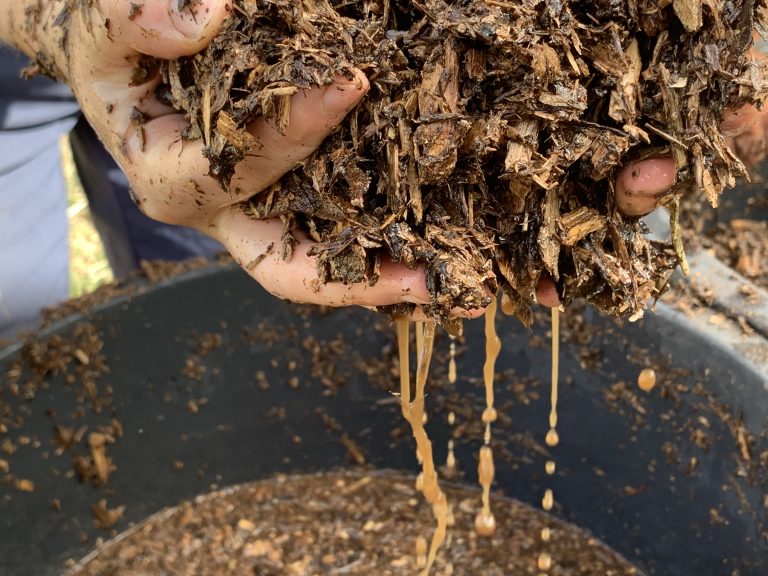
What If Health Began in the Soil? GreenRoots Festival returns to Badolato for its second edition — Saturday, 12 September 2026   Last year, a simple question brought people together on a Calabrian hillside: what makes a soil truly alive?This September, GreenRoots Festival comes back to Badolato (CZ) for its second edition, and this time the question grows roots that reach even further: From the life beneath our feet, to the life inside us, to the life we build together as a community. This second edition is made possible by the European Erasmus+ programme, whose support lets us keep the whole day open and completely free.  And there’s another change worth celebrating: this year the festival is led almost entirely by Terranima, joined by our guest Giorgia Liberati (Radici Connesse), an environmental engineer and soil-microscopy specialist.  What began as an experiment has become something our own community can now carry forward — and that, in itself, is a small act of regeneration. From compost to community The day moves from the hands-on and practical to the quietly profound. We begin with compost — learning to raise the microbes that bring soil to life — and follow that thread all the way to the connection between the health of the soil and our own health. Because the same invisible world that feeds a plant also lives inside us. And when the workshops end, the day doesn’t. This year we’re adding a new chapter: a moment of social regeneration. As the afternoon turns to evening, the wood-fired oven comes to life, music plays, and the courses give way to conversation. Other activities are still taking shape to round out the day — all part of the same idea: slowing down and enjoying one another’s company. Regenerating the soil, after all, also means regenerating our relationships — the ones we build over a shared meal, a good drink, and an unhurried talk under the open Calabrian sky. Because learning together is one thing. Growing together is another. Why Calabria, why Badolato Events like this matter everywhere — but they matter especially here. In Calabria, where so much land and talent are too often overlooked, a festival like GreenRoots does more than teach techniques. It brings people together, gives farmers and curious neighbours a reason to meet, and shows that innovation and care for the land can happen right here, at home. Little by little, we’d love for Badolato to become a reference point in the region for this kind of gathering — a place people associate with soil, learning, and community. Last year, folks came from all around, and many now link this festival with the town itself. That’s exactly the kind of root we want to grow: one that holds, and spreads. Diversity is resilience If there’s one lesson the soil teaches, it’s this: the healthiest ground is the most diverse. A soil rich in different forms of life is a soil that resists drought, disease, and shock. The same is true for us. Last year’s edition brought together an extraordinary mix of people — farmers, gardeners, first-time composters, health and wellness professionals, young and old. That diversity was the festival’s real success. And it’s more than a nice image: diversity is resilience, and resilience is how we build a future that’s more solid, stronger, richer, and better prepared for whatever comes. Join us GreenRoots Festival 2026 is free, but places are limited and registration is required. Everything you need — the full programme, the day’s schedule, and how to sign up — is on the festival page: → Programme & registration — GreenRoots Festival 2026 Curious how it all began? Take a look back at last year’s first edition. See you in Badolato on Saturday, 12 September. Bring your curiosity — we’ll bring the compost, the music, and the wood-fired oven.

E se la salute cominciasse dal suolo? Leggi tutto »

Green Roots Festival: suolo, persone e semi di rigenerazione

Terranima Festival GReenroots

Green Roots Festival: Soil, People, and the Seeds of Regeneration Badolato, Calabria – June 12–13, 2025   What happens when you bring together farmers, gardeners, dreamers, and doers from all corners of Calabria? When young people and elders, city dwellers and countryside veterans sit under the same olive tree to learn about soil life and microbial magic? Something powerful happens. Something that feels like regeneration—not only of agriculture, but of community. This was the spirit of the Green Roots Festival, a two-day workshop on regenerative farming and soil microbiology held at Terranima’s land in the hills of Badolato. The event was supported by the Erasmus+ Programme of the European Union and hosted in collaboration with Slovak Eco Quality (SEQ).   From the very beginning, the energy was palpable. Participants arrived curious, open, and ready to dive in. Over 30 people each day, from different parts of Calabria and beyond, gathered to learn from Axel Torrejón, a Chilean agroecologist and consultant known for his engaging, hands-on approach to teaching. And the group? A beautiful mix. Farmers in their sixties stood next to young students; local food producers swapped ideas with hobby gardeners and permaculturists. It wasn’t just about microbes—it was about connection. Between people, between generations, and between humans and the soil. Soil, microbes… and something more Over two days, participants explored key concepts of soil health, plant nutrition, and natural resilience. They learned how to prepare biofertilizers, grow beneficial microorganisms, and even trap native fungi and bacteria from the local environment using simple, low-cost techniques. But more than that, they learned how to observe nature. Axel’s teaching style made even the most complex microbiology feel accessible. Despite the heat, the group stayed fully engaged. Laughter, questions, and “aha!” moments flowed freely. And when it came to the practical parts? People got their hands dirty. They mixed, observed, built, shared. Some even took rice traps home to see what tiny life forms they could collect from their own land. Regeneration Soil and Society There’s something special about watching strangers become collaborators. About seeing young people ask questions with spark in their eyes, and older farmers nod in deep understanding. What emerged during the festival was a kind of social regeneration—a reminder that agriculture isn’t just about food. It’s about culture, landscape, health, identity. And when people who care about these things come together, something begins to shift. Terranima aims to become a reference point for this kind of transformation—connecting people who share values and visions, and offering a space where new ideas can take root. Slow lunches, big ideas The long lunch breaks weren’t just about food (though the food was delicious). They were a time for networking, reflection, and exchange. People sat in the shade, shared stories, and made plans. Some want to collaborate. Others want to bring Axel back. Everyone wanted more. In fact, the most frequent feedback we received? “Let’s do this more often!” A community effort   None of this would have been possible without the incredible volunteers—Simone, Yamila, and Veda—who helped organize, host, guide, and support every detail of the event. Also, thanks to our neighbours and friends who agreed to use their space for parking, or borrowed chairs and straw bales. And yes, no plastic was used: everyone had a reusable cup labeled with a clothespin for their coffee and water. Looking Ahead The Green Roots Festival was just the beginning.   The response from participants was clear: there’s a real hunger in Calabria for practical knowledge, inspiration, and community around regenerative practices.   We’re already dreaming of the next edition—maybe in a cooler season, and maybe spread out over more days to give even more space for reflection and participation.   The seeds have been planted, and we can’t wait to see what grows. Special thanks to the Erasmus+ (Programme of the European Union), to our friends at Slovak Eco Quality (SEQ, Marco, Gabriela, Agnes and Kristina, and from BROZ.sk with Karolina and Mario), to Axel Torrejón for his passion and clarity, to Chiara and Paola for their help with translating, and to everyone who showed up ready to learn and share.   And of course, our deepest thanks to the volunteers, without whom none of this would have been possible.   Let’s keep growing, regenerating, and rooting ourselves in what matters. Participants during the event Axel showing some of the treatments Some of the preparations with rice and milk Participants Participants smelling soil Axel in action Axel explaining soil health Networking Networking Networking Axel presentation Participants Overview of the workshop Axel presenting Participants Chiara and Paola who helped with translation Marco and Gabriela from SEQ Group picture

Green Roots Festival: suolo, persone e semi di rigenerazione Leggi tutto »

Il Sud Italia si Racconta: Le Voci degli Agricoltori tra Speranze e Preoccupazioni per un Futuro Rigenerativo

Southern Italy Speaks: Farmers Share Hopes and Worries for a Regenerative Future This article is based on a survey carried out as part of GreenRoots, a two-year initiative co-funded by the European Union. The project’s goal is to support the transition to a more regenerative and organic agriculture by designing events, workshops, and online learning modules tailored to real needs. The insights presented here come directly from farmers and agricultural professionals in Southern Italy — their challenges, their dreams, and their readiness for change. Who took part? The majority of respondents are active farmers who produce and sell their own crops, especially olives, vegetables, and fruit trees. A smaller group includes agronomists, consultants, and those working in agricultural supply chains. What emerges clearly from the data is a strong connection to the land and a preference for tools that are practical, low-impact, and suited to small- to medium-scale production. Here’s what they use most to work their fields: Manual tools are incredibly common but hand hoes (zappa manuale) is the undisputed protagonist. Small-scale mechanization is also popular, with many relying on rototillers (fresa), flail mower (trincia) and motor hoes (motozappa) to manage soil and residues. Some are experimenting with regenerative tools like the grelinette (broadfork) — a sign of growing interest in soil-friendly methods. A handful mentioned working entirely by hand, showing the persistence of manual labor and traditional methods in the region. This tool diversity reflects both the constraints and creativity of farming in Southern Italy — where innovation often coexists with resilience and a deep-rooted sense of place.   What Worries Farmers the Most? Participants expressed strong concern about the long-term sustainability of current agricultural practices. The top concern? The impact of chemical substances (particularly fertilizers and pesticides) on both soil health and food quality. Other recurring themes include nutrient loss in food and economic pressure from input costs. What They Believe (and What They Don’t) Farmers were asked to rank their level of agreement (from 1 to 5) with several key statements. Here’s what stood out: Soil health is crucial: Nearly all respondents gave the highest score to the statement “Soil health is one of the most important factors for producing nutritious food” (average score: 4.8). Many believe that food quality has declined over the last two decades due to industrial practices. Interestingly, most do not believe the cost of synthetic inputs is justified by their results (average score: 1.7). What Motivates Change? When asked what might convince them to adopt more sustainable methods, participants cited: Environmental benefits (better soil, cleaner water), Economic incentives (subsidies or reduced input costs), and Greater knowledge and support. Barriers included lack of technical knowledge, access to natural inputs, and market uncertainty for sustainable products. What They Want to Learn The good news? Interest in learning is strong: 73% want to improve soil health 49% are eager to learn about composting and natural fertilization 44% want to boost profitability with sustainable practices 44% also want tools to manage pests and diseases naturally There’s a growing movement toward knowledge-based, regenerative farming — and farmers are ready to lead it. Final Thoughts The message is clear: farmers in Southern Italy are ready for change, but they need support, knowledge, and community to make that transition confidently. They’re aware of the problems, they value their land, and they’re open to solutions that respect both tradition and ecology. That’s exactly why we’re organizing the Regenerative Agriculture Workshop on June 12–13. Whether you’re a farmer, agronomist, or simply curious about healthier and more sustainable ways of working the land, this two-day workshop is for you. The event blends theory and hands-on experience, covering topics like: Understanding soil microbiology Production of biofertilizers Tools and techniques for low-input, high-resilience systems You’ll get to see practices in action, exchange with other growers, and go home with real strategies you can apply immediately. Info event

Il Sud Italia si Racconta: Le Voci degli Agricoltori tra Speranze e Preoccupazioni per un Futuro Rigenerativo Leggi tutto »

it_ITIT