
Plants Are Not Vegetarians
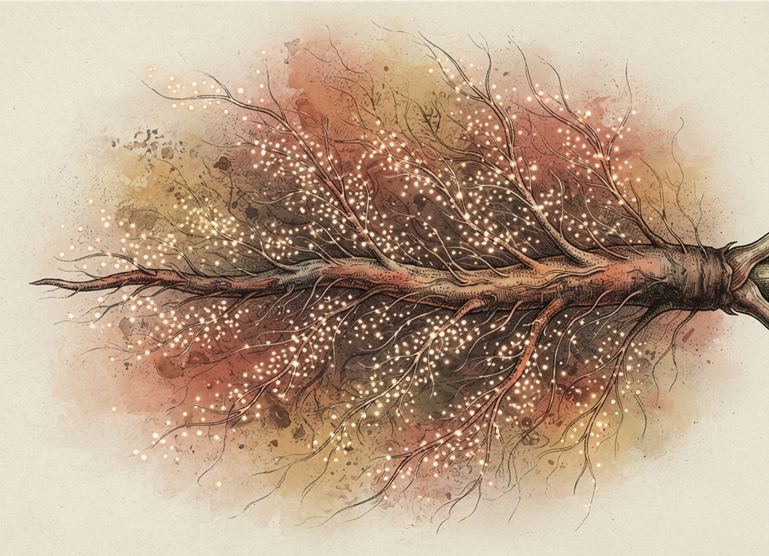
From under the microscope Plants Are Not Vegetarians What a microscope keeps showing us about how roots really eat — and what we’ve quietly bred out of our seeds. It sounds like a provocation. But the longer we spend with soil under the microscope, the more literally we mean it. For most of the last century we pictured a root as a straw. Passive. Sipping dissolved minerals from the water around it, the way you draw lemonade through a paper tube. Nitrogen in, phosphorus in, potassium in — a plumbing problem, and one we learned to “solve” by pouring the missing elements into the ground in soluble form. That picture built modern agriculture. It also turns out to be, at best, half the story. The other half is stranger. It’s the part we want to tell you about. The root that farms its own food Start with the image most of us carry from school: the legume and its root nodules, little pink factories where bacteria pull nitrogen out of thin air and hand it to the plant. Beautiful, famous — and, it turns out, the loud exception rather than the rule. The quiet rule may be something else entirely. Researchers like James White at Rutgers have spent years describing a process they call the rhizophagy cycle — literally, root-eating. And it looks less like plumbing than like husbandry. Here is roughly how it goes. At the growing tip of a root, the plant leaks sugars, proteins and vitamins into the soil around it, and bacteria come to the table. The youngest root cells, right at the tip, haven’t hardened their walls yet — and the plant lets the bacteria in, into the narrow space between the cell wall and the living membrane. Once inside, the bacteria shed their own walls and go soft and naked. Then the plant does something that stops sounding like symbiosis and starts sounding like digestion: it hits them with a burst of reactive oxygen — superoxide, the same class of molecule your immune cells use to kill invaders — and the oxidation makes the microbes leak. The plant harvests what spills out: nitrogen, minerals, the things it needs. Not all of them are consumed. The survivors get pushed out toward the skin of the root, where they trigger a root hair to start elongating, and they ride that growing hair outward — rebuilding their walls with a little sugar the plant feeds them on the way — until they slip back out the tip into the soil. There they refill with nutrients, and the whole cycle starts again. A few go in. Because they multiply while they’re inside, more come back out than went in. And here’s the detail that stopped us: in White’s experiments, the root hair barely grows at all when the bacteria aren’t there. The hair and the microbe are not two things that happen to share space. The hair seems to be built for the traffic. The plant isn’t feeding on microbes the way a cow feeds on grass. It’s keeping a herd. It’s farming them. What we quietly bred out Now hold that next to a weed. A wild plant matures out in the open, exposed, colonised by whatever its ground and its neighbours throw at it. Whatever survives that gauntlet, it carries — often right into its seed, passed down to the next generation like an inheritance. The community stays intact. Our crop seed doesn’t work that way. We produce it clean. Uniform. Selected, generation after generation, for yield and for how the plant looks above ground — never once for the biology it carries below. And the evidence is starting to catch up with what that costs. Wild relatives of our crops, and the least-domesticated varieties we still have, tend to carry richer, more diverse microbial communities inside their seed than the polished modern lines bred from them. In maize, the ancient relatives from its center of origin carry endophytes that let them shrug off nitrogen-poor soil — precisely the trait we stopped selecting for the moment we started growing maize in a haze of cheap fertilizer. Breed a plant in abundance, and it forgets how to find its own. Breed it clean, and it travels without its crew. We gained uniformity. We can’t pretend we didn’t also give something up. We want to be honest here, because this is young science and we won’t dress it up. Nobody yet knows exactly which nutrients move through the rhizophagy cycle, or how much of a plant’s diet it really accounts for. Some reviews looking at domestication and the seed microbiome call the picture mixed, and they’re right to. This isn’t a finished story with a bow on it. But it lands on exactly what we keep seeing with our own eyes in the field. The first line of defence Because those internal microbes don’t only appear to feed the plant. They appear to defend it. Endophytes pulled from plants that survive brutal ground — desert species, plants growing in salt, plants rooted in metal-contaminated soil — have, in study after study, handed a measure of that toughness to ordinary crops when they’re reintroduced. Drought tolerance. Salt tolerance. The ability to keep growing where heavy metals would otherwise stall a plant cold. Read that again if you farm where we do. Drought and salt aren’t exotic stresses in the Mediterranean — they’re the forecast. They’re July. They’re the wind off the sea and the summer with no rain in it. The resilience we spend the whole season trying to buy in a sack, top up from a jug, spray on against the heat — a plant may already know how to build it, from the inside, when it still has the biology to do so. The thing we keep trying to purchase, the plant was doing on its own. When we let it. A plant is not an individual This is why, at Terranima, we’ve stopped thinking of
Plants Are Not Vegetarians Read More »


 EN
EN  IT
IT