
The day we raised the invisible
GreenRoots Festival 2026 — Badolato, one Saturday in September
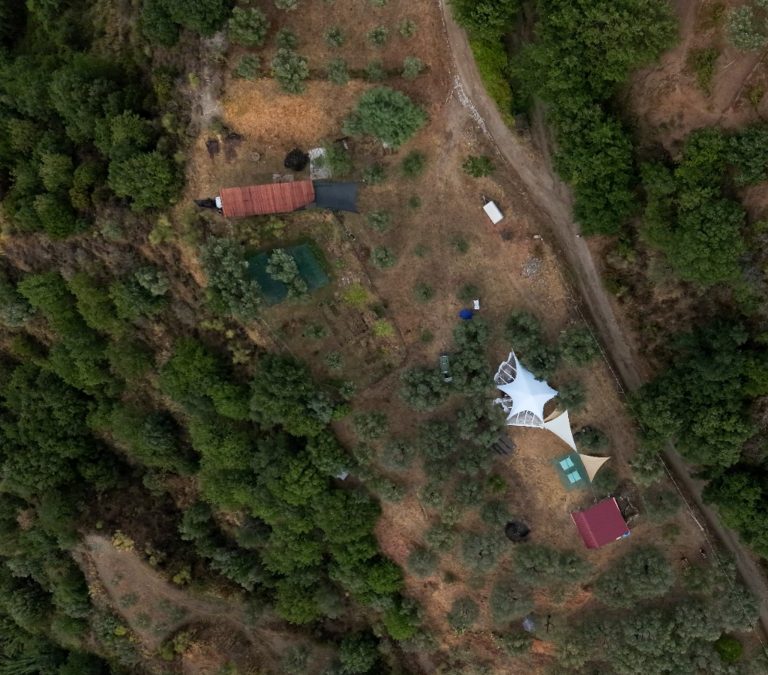
For days before the festival we kept watching the sky. Not for rain, at first, but for wind. We had spent weeks building a place that didn’t exist before: shade cloths stretched against the sun, a big central tent that would become the heart of everything. And then the wind came, hard and insistent, and we lay awake certain it would take the whole thing with it — the cloths, the tent, the weeks of work by six volunteers and our president, Roberta.
It held. All of it. By Saturday morning the wind had gone quiet, the tent was standing, and people were arriving.
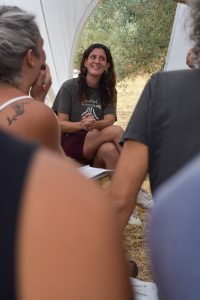
Roberta opened the day, and she opened it honestly. We are not here, she said, to tell anyone what they must do. We came to share a few things we have learned with our own hands, in our own soil, and to understand together how the ground and the plants and everything living between them actually work. We live in a moment when everything feels like too much — too big, too far from our own hands — and that feeling is exactly what tempts us to do nothing at all. And to what end? But there is an end. We are responsible for our own lives, our own gardens, our own fields, and that is already so much. One grain of sand makes someone else want to add theirs. The grain becomes a heap, and the heap becomes a revolution. You believe it too, she told the room, or you wouldn’t have woken early on a Saturday to come to Badolato.
Then it was time for the word that would carry the morning: compost.
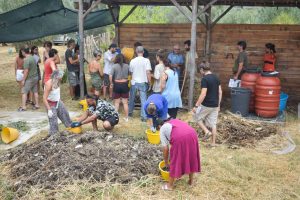
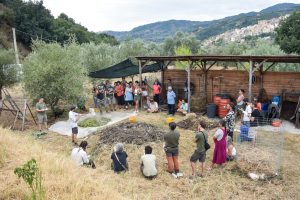
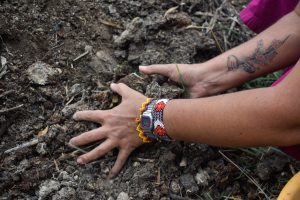
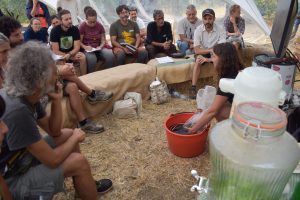
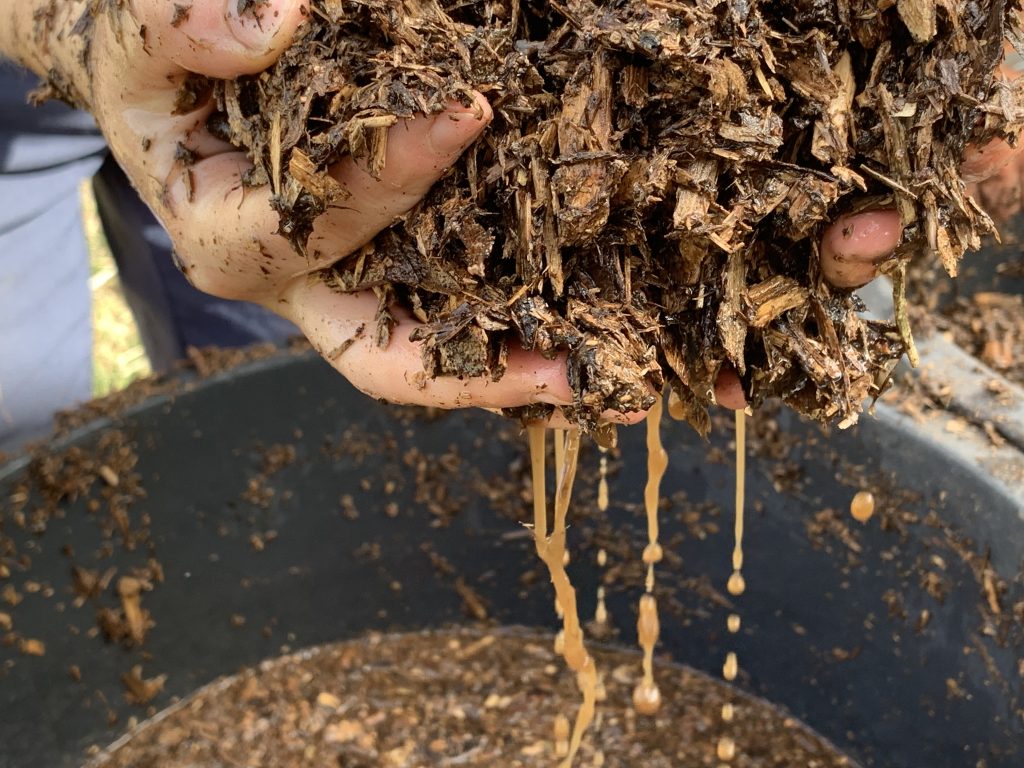
We walked to the composting area together, notebooks out, and built a hot pile there and then, layer by layer, talking through each one. A few days earlier the volunteers had built a second pile, so that when the thermometer went in, everyone could read the number for themselves. The needle had climbed deep into the heat of active decomposition. You can talk about microbial activity all you like; it is another thing to put your hand near a heap of dead material and feel it giving off warmth like a living body.
After the coffee break came the part we love most to teach. It starts, as all of it does, with photosynthesis — and with the strange, generous fact that a plant sends much of the sugar it makes down into the soil, on purpose, to feed the life around its roots.
From there the whole invisible cast: bacteria, fungi, protozoa, nematodes — each of our tiny friends carrying its own tools, the bacteria with little more than a screwdriver, the fungi a whole toolbox — eating one another and passing minerals along until they reach the plant that started it all. There were questions. There were faces that changed halfway through a sentence. And then rhizophagy — plants pulling bacteria in through their roots, digesting them, letting them go again. Plants, it turns out, are not vegetarians. We have rarely seen a room wake up so fast.
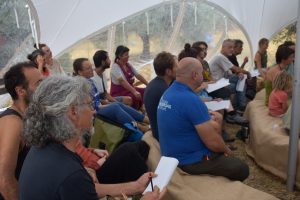
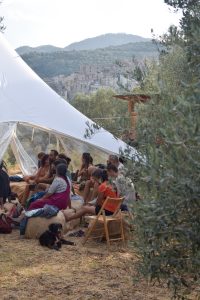
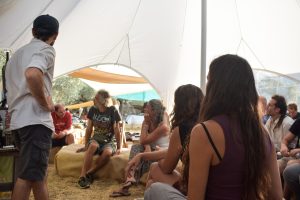
Then the rain came, hard at moments, and it did not matter at all, because the central tent did exactly what we had built it to do. Everyone stayed dry, and listening, under the sound of it.
Lunch arrived from a restaurant in Davoli: local dishes, generous, the kind of food that keeps people at the table longer than they meant to stay. That lingering is not a pause from the festival. It is the festival — the talking, the swapping of stories, the quiet forming of ties that only happens over a shared plate.
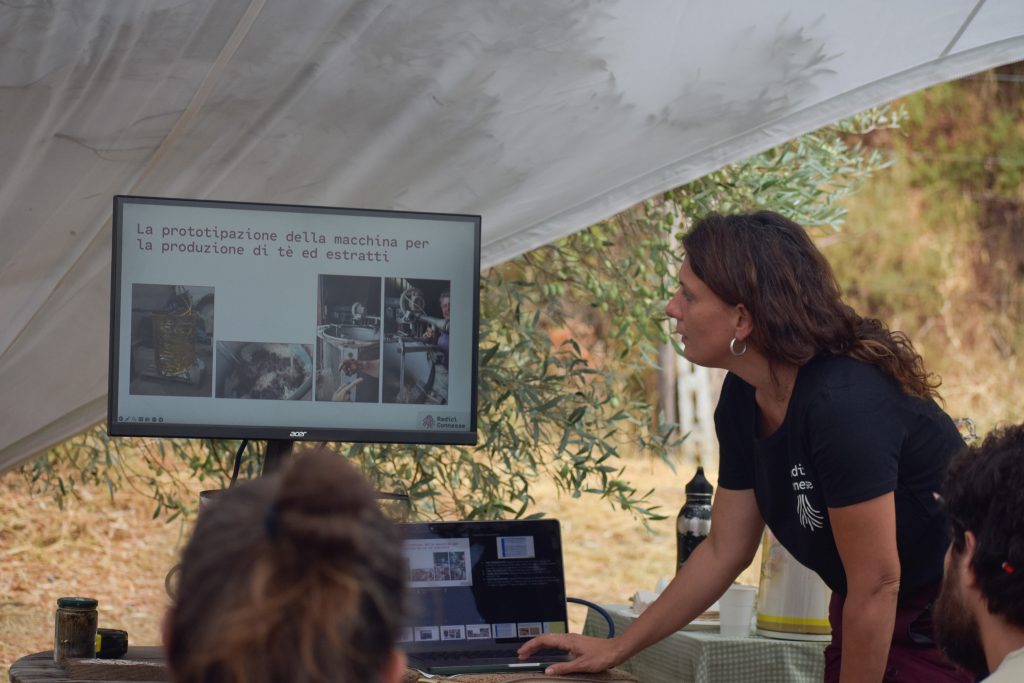
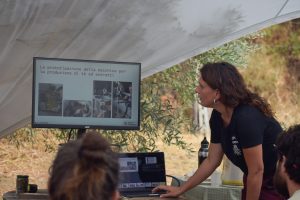
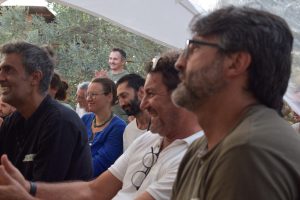
The afternoon belonged first to Giorgia Liberati, of Radici Connesse, who came to talk about compost extracts and teas. Her strength was that none of it stayed theoretical. She works in the north of Italy, and she brought numbers — real results on grapevines, on kiwi, even on olives. The questions came at her like a small storm, and she answered every one, until people weren’t only listening but offering their own experiments. It became a conversation.
Then we closed the teaching part of the day with the subject Terranima can’t stop thinking about: the parallel between the microbiology of the soil and the microbiology of our own gut. On the board we drew the two digestive systems side by side. The plant’s begins outside itself, in the sugars it feeds to the microbes at its roots, the way ours begins at the mouth; the first worms and insects breaking material down are a kind of teeth. And then the line that tends to land hardest: we spray antibiotics on our fields, several times a year, and then wonder why the soil forgets how to digest.
So we ended with a question of our own. How do we actually change this? Where would you even begin? Some were sure these practices could never work at scale. Others answered that they already do, and gave examples. And then one participant offered something simple and concrete: a group of us, one piece of land, a shared trial — learn it together, prove it together. By the end, contacts had been exchanged, and two local growers had agreed to try these methods on their own land, alongside Terranima and Giorgia: one with olives and citrus, and another farming just outside Badolato. Ideas came out of that last hour that we genuinely hope take root in the weeks ahead.
Some of the people under the tent had been with us the year before, and told us, quietly, that the festival had changed how they work their soil — that they had gone home, tried the preparations, and watched them work.
You were wonderfully clear, passing on your knowledge in a way that was simple and full of love — enough to make us want to begin, and to keep going. Thank you, from the heart.
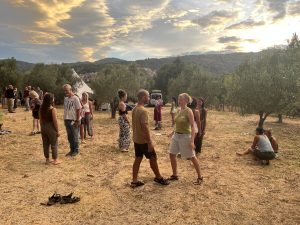
Then the day changed shape. Three sessions bridged the space between the learning and the evening: dance with Yamila, yoga with Giuseppe, and a session with Lorena that wove movement together with writing. This was the hinge, where the workshop softened into something more shared, more bodily. And the convivial part built itself, the way the best parts always do. Some people who had spent the day at the course stayed. People who arrived only in the afternoon joined, including some who hadn’t managed to get a place at the workshop but didn’t want to miss the social regeneration.
The pizza, from the wood-fired oven, was loved. The music was loved. The lights strung between the olive trees were loved. Children, older people, a dog or two, farmers, the simply curious — all of it braided into one evening of music and dancing and easy company under the trees.
It was beautiful to stand back and watch. And you could tell the people there felt it too.
We built this day to keep people out of the sun and the rain, and it did. But what we were really building was a place where soil and people could both be tended at once — where you do not need to already be a farmer to belong.
If any of this makes you want to be here next time: good. Come. We’ll leave the lights on between the olives.
Photographs from the day by Yami Gardeliando — thank you, Yami, for letting us live it all again.
 EN
 IT